Ride video
POV, off-ride, and preview clips embedded from rights holders — we never re-host video files.
Official park YouTube · Watch on YouTube
Sign in to contribute your own photo of The Racer.
Help improve this page
Signed-in accounts can suggest fact updates with a source link. Changes go live only after review.
Sign in to suggest an update →
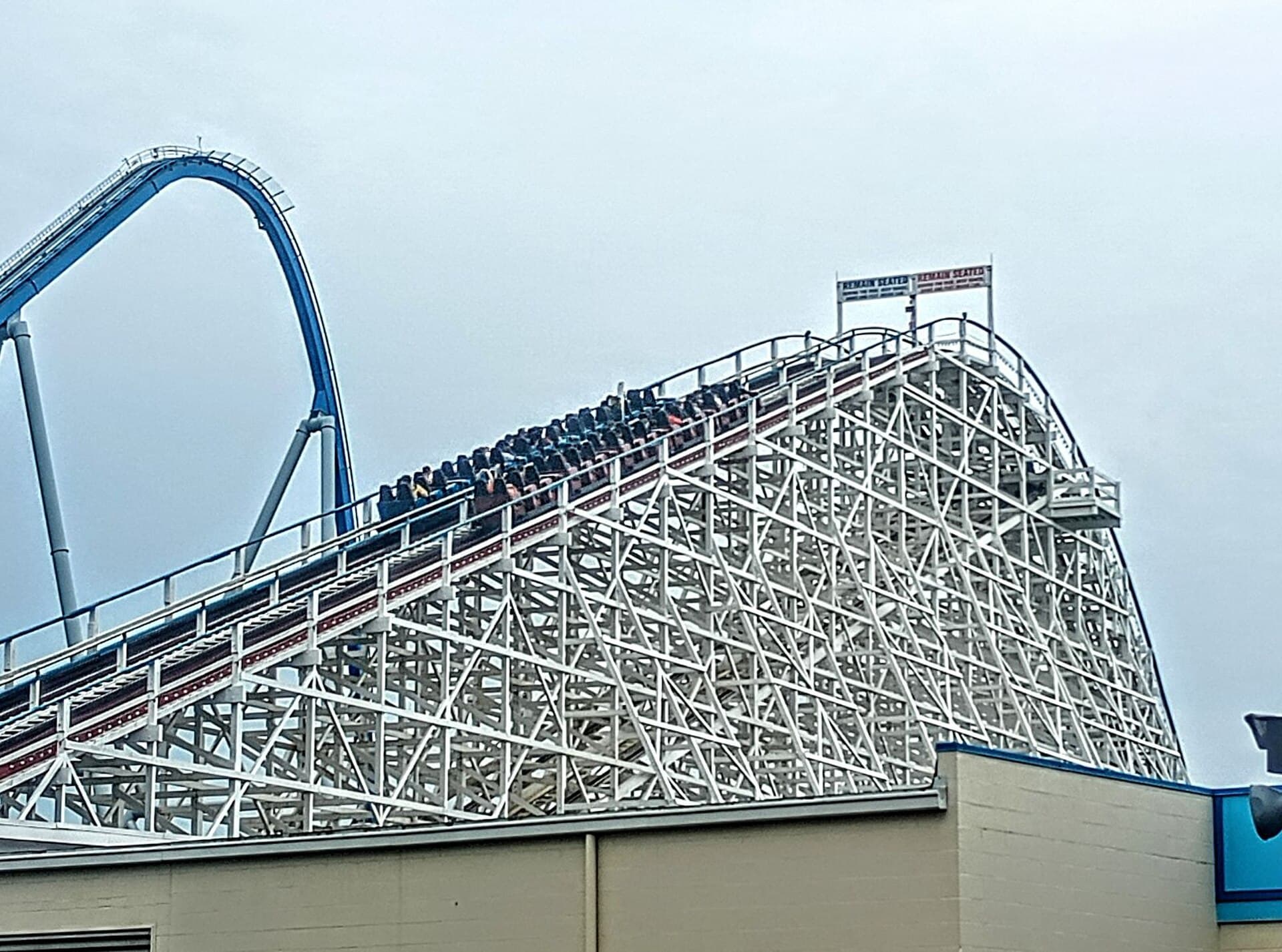
The Racer's twin wooden tracks — Blue and Red — have run side-by-side through Coney Mall since Kings Island's opening day in 1972, and Philadelphia Toboggan Company's design is widely credited with reigniting the wooden coaster industry after a mid-century building drought. It was assembled from prefabricated track sections erected from ground level rather than built up piece by piece, an approach unusual for its era that let the park finish construction on schedule. The Racer appeared in a 1973 episode of The Brady Bunch filmed on-site and has delivered more than 104 million rides — the most of any attraction in park history.
Specifications
Stats can be shown in imperial or metric — your choice is remembered on this device.
Ride profile
Scaled against Kings Island's operating coasters
Park intensity
Height
88 ft
#8 of 14 at Kings Island
Ride experience
- Racing
- Ptc
- Wood
Ride details
Min height
4'
Track
Wood
Specs from sixflags.com
Learn more
Rocky Mountain hybrid coasters
Steel track on reinvented wooden structures — steep, twisted, and often relentless.
Track compliance — why wood feels alive
Wood flexes; steel is stiffer — the same forces feel different on each structure.
Twister layouts
Helixes and direction changes stacked in one direction — classic wooden feel.
Wooden vs steel coasters
Structure and maintenance differ, but the question for riders is feel — vibration, sound, and how the train moves.
History
Sourced timeline and background for The Racer.
Timeline
1972
The Racer opens
PTC's twin-track wooden coaster debuts as one of Kings Island's opening-day signature attractions.
1982
South track begins running backward
Kings Island reverses one train to run backward — the first full-length wooden racing coaster to do so — originally intended as a one-season novelty.
2008
Both tracks restored to forward-running
Cedar Fair restores forward operation on both sides, formally naming them Blue Racer and Red Racer.
2007
ACE Roller Coaster Landmark
American Coaster Enthusiasts designates The Racer a Roller Coaster Landmark.
Background
Kings Island opened in 1972 needing a signature ride to replace Cincinnati's flooded-out Coney Island amusement park, and turned to legendary designer John C. Allen — coaxed out of semi-retirement — to build a wooden coaster that could anchor the new park's opening day.
Allen and the Philadelphia Toboggan Company erected The Racer's twin 88-foot tracks from prefabricated sections lifted into place and bolted together at ground level, an assembly method unusual for its era that let the park finish construction on schedule for an April 29, 1972 opening. The Blue and Red trains raced side-by-side along parallel courses, and the ride is widely credited with reigniting a national wooden-coaster building boom that had gone dormant since the 1940s.
In May 1982 one of the two tracks began running its train backward — a novelty meant to distract guests frustrated by frequent closures on the newly opened Bat — and the "backward Racer" proved so popular that Kings Island kept it running that way for 26 seasons before restoring both tracks to forward-facing operation in 2008. The Racer appeared in a 1973 episode of The Brady Bunch filmed on-site and earned American Coaster Enthusiasts' Roller Coaster Landmark designation in 2007.
More than 50 years and over 100 million rides later, The Racer remains Coney Mall's centerpiece and the most-ridden attraction in Kings Island history.
Notable records
first of kind · World
First roller coaster built structurally on the ground with prefabricated track sections lifted into position and bolted
As of 1972
History primarily sourced from sixflags.com. See also our data policy.
Log & review
Create a free account to track rides and share ratings with other enthusiasts.
Sign up to log ridesMore coasters at Kings Island
More coasters in Coney Mall and around Kings Island.
.jpg%2F960px-Invertigo_(Kings_Island).jpg&w=3840&q=75)
_1.jpg%2F960px-Flight_of_Fear_(Kings_Island)_1.jpg&w=3840&q=75)
_01.jpg%2F960px-Orion_(Kings_Island)_01.jpg&w=3840&q=75)
_01.jpg%2F960px-Banshee_(Kings_Island)_01.jpg&w=3840&q=75)
More rides at Kings Island
More in Coney Mall and nearby — keep planning your Kings Island day.
Sources & official links
We link out to parks, manufacturers, and the pages where facts and media come from.
- Kings Island — official sitesixflags.com(opens in a new tab)
- Kings Island on Coaster AtlasPark page
- Ride specifications sourcesixflags.com(opens in a new tab)
- Philadelphia Toboggan Coasters — manufacturerptcoasters.com(opens in a new tab)
- Hero photo (See Commons · CC BY-SA 4.0)Image license & attribution(opens in a new tab)
- Official POV — Official park YouTubeWatch on YouTube(opens in a new tab)
- History & background sourcesixflags.com(opens in a new tab)