Ride video
POV, off-ride, and preview clips embedded from rights holders — we never re-host video files.
Official park YouTube · Watch on YouTube
Sign in to contribute your own photo of Jack Rabbit.
Help improve this page
Signed-in accounts can suggest fact updates with a source link. Changes go live only after review.
Sign in to suggest an update →
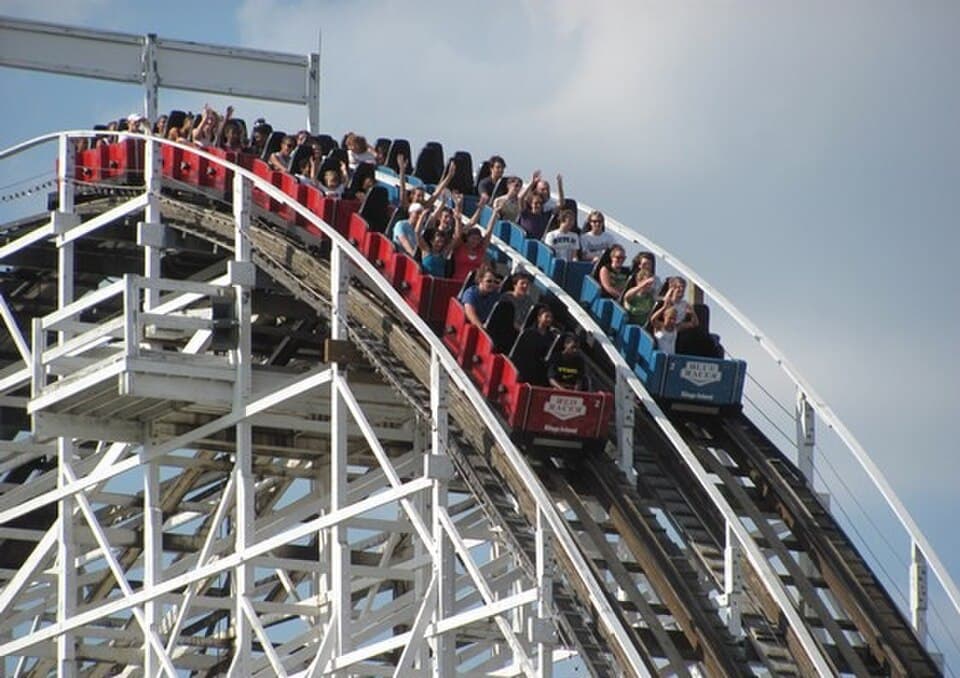
Jack Rabbit has operated on Kennywood's natural ravine terrain since June 18, 1920, making it the fifth-oldest roller coaster in the world and the second-oldest still running in the United States. John A. Miller and Harry Baker designed the ride specifically to showcase Miller's newly patented underfriction wheels, which locked trains to the track and enabled a much steeper, more daring drop than earlier coasters could safely attempt. The ride's signature feature is its 70-foot double-dip — an uncommon mid-course lift hill followed immediately by two rapid drops into a ravine that produce some of the strongest sustained airtime of any classic wood coaster still running. More than a century after opening, Jack Rabbit remains one of the most historically significant roller coasters in the world and a designated National Historic Landmark.
Specifications
Stats can be shown in imperial or metric — your choice is remembered on this device.
Ride profile
Scaled against Kennywood's operating coasters
Park intensity
Height
70 ft
#5 of 7 at Kennywood
Ride experience
- Ace Landmark
- Wood
Specs from kennywood.com
Learn more
Rocky Mountain hybrid coasters
Steel track on reinvented wooden structures — steep, twisted, and often relentless.
Track compliance — why wood feels alive
Wood flexes; steel is stiffer — the same forces feel different on each structure.
Twister layouts
Helixes and direction changes stacked in one direction — classic wooden feel.
Wooden vs steel coasters
Structure and maintenance differ, but the question for riders is feel — vibration, sound, and how the train moves.
History
Sourced timeline and background for Jack Rabbit.
Timeline
1920
Jack Rabbit opens
Fifth-oldest roller coaster in the world; first Kennywood ride to feature Miller's underfriction wheels.
Background
Kennywood opened Jack Rabbit on June 18, 1920, near the start of the Roaring Twenties amusement park boom, as its fourth roller coaster and the first anywhere at the park to use John A. Miller's newly patented underfriction wheels. Designed by Miller and Harry Baker and built under the supervision of Charles J. Mach at a cost of $50,000, the ride's underfriction system locked trains to the rails, allowing far steeper and more daring drops than earlier coasters could safely execute.
The layout is built entirely around a natural ravine, using an uncommon mid-course lift hill rather than a single climb at the start, followed immediately by the ride's signature 68-foot, 6-inch double-dip — two rapid drops in succession that generate some of the strongest sustained airtime of any surviving wood coaster from the era. A dark tunnel originally covered the ride's lower turnaround but was removed in the 1940s before being restored, at a slightly shorter length, prior to the 1991 season.
The ride's original open-front trains were replaced in 1951 by Kennywood's own Edward Vettel Sr. with the stationary lap-bar trains still in use today, a rare instance of a century-old wood coaster retaining trains built specifically for it more than 70 years ago.
As Kennywood's oldest surviving coaster and one of the oldest continuously operating roller coasters anywhere in the world, Jack Rabbit was central to the park's 1987 designation as a National Historic Landmark.
Notable records
other · World
Fifth-oldest operating roller coaster in the world and second-oldest in the United States.
As of 1920
History primarily sourced from kennywood.com. See also our data policy.
Log & review
Create a free account to track rides and share ratings with other enthusiasts.
Sign up to log ridesMore coasters at Kennywood
More coasters in Racer Valley and around Kennywood.




More rides at Kennywood
More in Racer Valley and nearby — keep planning your Kennywood day.
Sources & official links
We link out to parks, manufacturers, and the pages where facts and media come from.
- Kennywood — official sitekennywood.com(opens in a new tab)
- Kennywood on Coaster AtlasPark page
- Ride specifications sourcekennywood.com(opens in a new tab)
- Philadelphia Toboggan Coasters — manufacturerptcoasters.com(opens in a new tab)
- Hero photo (See Commons · CC BY-SA 4.0)Image license & attribution(opens in a new tab)
- Official POV — Official park YouTubeWatch on YouTube(opens in a new tab)
- History & background sourcekennywood.com(opens in a new tab)